New Regulations and Policies | Nanning
Announces Support for the Application of Cadmium Telluride and Perovskite
Thin-Film Solar Cell Technology and Equipment in the Construction Sector
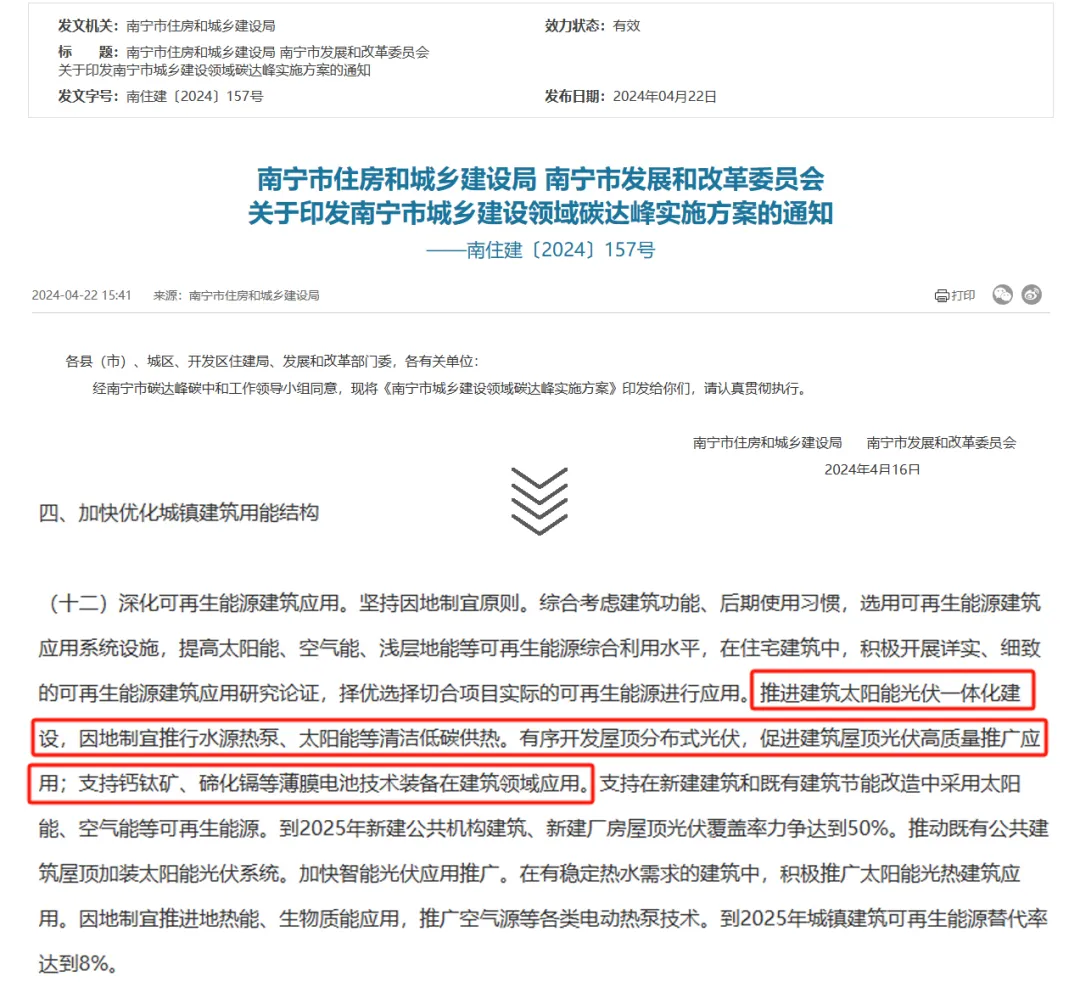
Recently, the Nanning Municipal Housing and
Urban-Rural Development Bureau and the Nanning Municipal Development and Reform
Commission of Guangxi Province issued the "Nanning City Carbon Peaking
Implementation Plan." The notice explicitly calls for promoting the
integrated construction of solar photovoltaics in buildings, promoting clean,
low-carbon heating methods such as water-source heat pumps and solar energy
according to local conditions, orderly developing distributed rooftop
photovoltaics, and promoting the high-quality application of rooftop
photovoltaics in buildings; and supporting the application of perovskite,
cadmium telluride, and other thin-film solar cell technology and equipment in
the construction sector.

With the proposed "carbon
peaking" and "carbon neutrality" goals in my country, all
industries are transitioning to green and low-carbon development. Buildings, as
major carbon emitters, are undoubtedly a key factor in achieving the "dual
carbon" goals. Against this backdrop, the green transformation of the
construction industry presents new development opportunities for
building-integrated solar (BIPV). Power-generating glass, based on cadmium
telluride and perovskite thin-film solar cell technology, is a new green
building material that converts sunlight into electricity.

Cadmium telluride and perovskite
solar-generating glass can be applied to building exterior walls, windows,
roofs, and other areas, enabling self-generated electricity generation for
buildings or grid-connected power. Dubbed "wall-mounted oil fields,"
they are a crucial component of future urban architecture. The principle is to
evenly apply or coat ordinary glass with cadmium telluride or perovskite
photovoltaic materials, transforming the previously insulating glass into a
conductive conductor. This absorbs visible and ultraviolet light from sunlight
and converts it into electricity, generating electricity.
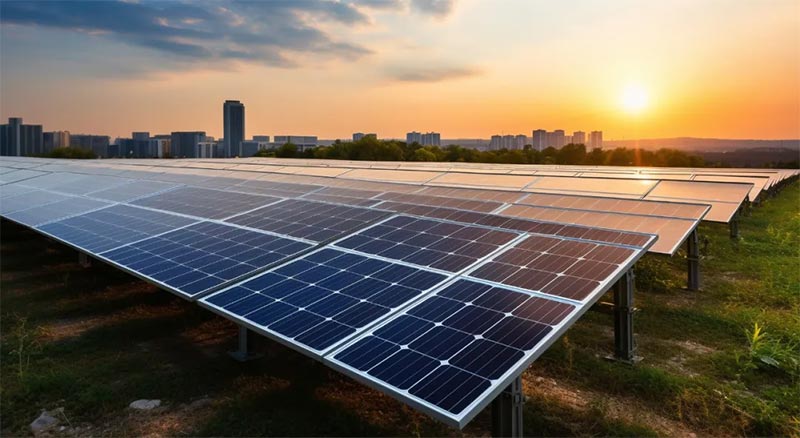
Notably, unlike traditional crystalline
silicon solar cells, cadmium telluride and perovskite solar-generating glass
can achieve photoelectric conversion even in low-light conditions, truly
achieving "where there is light, there is electricity," thus
possessing broad application prospects.
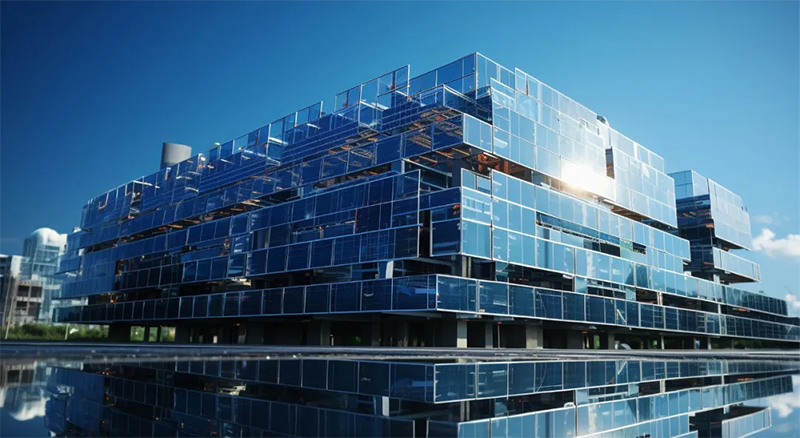
Firstly, cadmium telluride and perovskite
solar-generating glass can enable self-generated electricity generation for
buildings or grid-connected power generation, thereby reducing reliance on
traditional energy sources and lowering energy consumption and emissions.
Secondly, cadmium telluride and perovskite power-generating glass can be
applied to building exterior walls, windows, roofs, and other areas. Not only
does it generate electricity, it also provides insulation, sunshade, and
thermal insulation, improving energy efficiency and comfort, truly transforming
building materials from "energy-saving" to
"energy-creating." Furthermore, cadmium telluride and perovskite
power-generating glass can also be used in transportation, electronic
equipment, and other fields, contributing to energy conservation and emission
reduction across various industries.
As a technological innovation in the fields
of new energy and new materials, Zhongmao Green Energy Technology (Xi'an) Co.,
Ltd., based in the Qinchuangyuan main window in the Xixian New District, is
committed to "enhancing value through technology and transforming lives
through green development." Collaborating with renowned universities such
as Xi'an Jiaotong University, the company integrates industry, academia, and
research to develop, produce, and manufacture thin-film solar cell chips. The
company focuses on the research and development and application of CdTe
thin-film photovoltaic modules, conducting technological research and promoting
the commercialization of these technologies. Its cell conversion efficiency has
reached internationally leading levels.
After years of development, Zhongmao Green
Energy Technology's cadmium telluride solar glass products boast strong power
generation capacity and high safety performance. They can be flexibly
customized to meet customer needs in terms of color, pattern, shape, size, and
light transmittance, creating enormous potential and opportunities for the
construction, industrial, and other sectors. Driven by favorable policies,
demand for cadmium telluride thin-film photovoltaic modules will further expand
in the future. Zhongmao Green Energy Technology will establish its presence in
the Xixian New Area and expand nationwide, aiming to make every city a green
city that integrates ecology and technology, and jointly usher in a green and
sustainable future.
Attachment: The full text of Nanning City's
"Nanning City Carbon Peaking Implementation Plan for Urban and Rural
Construction" is as follows:
Urban and rural construction is one of the
main sources of carbon emissions. To thoroughly implement Xi Jinping Thought on
Ecological Civilization and the decisions and deployments of the Party Central
Committee and the State Council on carbon peak and carbon neutrality, this
implementation plan has been formulated in accordance with the "Notice of
the Ministry of Housing and Urban-Rural Development and the National Development
and Reform Commission on Issuing the Carbon Peak Implementation Plan for Urban
and Rural Construction," the "Implementation Opinions of the Guangxi
Zhuang Autonomous Region Committee of the Communist Party of China and the
People's Government of Guangxi Zhuang Autonomous Region on Completely,
Accurately and Comprehensively Implementing the New Development Concept and
Doing a Good Job in Carbon Peak and Carbon Neutrality," the "Guangxi
Zhuang Autonomous Region Carbon Peak Implementation Plan," the "Guangxi
Zhuang Autonomous Region Carbon Peak Implementation Plan for Urban and Rural
Construction," the "Nanning City Carbon Peak Implementation Plan for
Completely, Accurately and Comprehensively Implementing the New Development
Concept and Doing a Good Job in Carbon Peak and Carbon Neutrality," and
the actual situation in Nanning. This plan aims to steadily advance carbon peak
efforts in urban and rural construction in Nanning and control the growth of
carbon emissions in this sector.
I. Overall Requirements
(I) Guiding Ideology Adhere to the guidance
of Xi Jinping Thought on Socialism with Chinese Characteristics for a New Era,
fully implement the spirit of the 20th National Congress of the Communist Party
of China, thoroughly implement the requirements of General Secretary Xi Jinping
on major strategies for Guangxi, focus on the "1+1+4+3+N" target task
system for building a magnificent Guangxi in the new era, fully implement the
deployment requirements of the Seventh Plenary Session of the 12th Autonomous Region
Party Committee and the Seventh Plenary Session of the 13th Municipal Party
Committee, adhere to the general working tone of seeking progress while
maintaining stability, based on the new development stage, fully, accurately
and comprehensively implement the new development concept, actively serve and
integrate into the new development pattern, adhere to ecological priority,
conservation priority, protection priority, adhere to the harmonious
coexistence of man and nature, and firmly Maintaining a systematic approach, we
will better coordinate the relationships between development and security,
development and emission reduction, the overall and local, the short-term and
medium- to long-term, and the government and the market. Guided by green and low-carbon
development, we will prioritize effectiveness, strengthen practical action, and
ensure implementation. We will advance Nanning's urban renewal and rural
development initiatives, accelerate the green transformation of urban and rural
development models, improve the quality of green and low-carbon development,
promote industrial upgrading, and ensure positive results in achieving carbon
peak in urban and rural construction. We will make due contributions to the
capital city of Guangxi in building a magnificent socialist Guangxi with
Chinese characteristics in the new era and strengthening my country's important
ecological barrier in southern China, continuously meeting the people's needs
for a better life.
(II) Working Principles
- Adhere to systematic planning and
step-by-step implementation, give full play to the guiding role of planning,
strengthen results-oriented control, scientifically and rationally determine
the pace of work and target tasks, and comprehensively promote the achievement
of carbon peak in the construction sector.
- Adhere to local conditions and
differentiated approaches based on specific categories, distinguish between
urban and rural areas, and scientifically determine energy conservation and
carbon reduction requirements.
-- Adhere to innovation-driven,
transformative development, strengthen core technology breakthroughs, improve
technological systems, enhance institutional innovation, improve carbon
emission management systems for urban and rural construction, and steadily, orderly,
and gradually transform urban and rural construction methods.
- Adhere to a dual-engine drive and joint
efforts, give full play to the role of government leadership and market
mechanisms, establish an effective incentive and constraint mechanism, implement
shared development and sharing, coordinate and advance various tasks, leverage
the unique regional advantages, and coordinate green and low-carbon
cooperation, such as building an international metropolis open to cooperation
with ASEAN and the China-ASEAN Cross-Border Industrial Integration Development
Cooperation Zone.
- Adhere to coordinated advancement and
prioritize conservation. Fully and accurately understand the profound impact of
the national and autonomous region's "dual carbon" strategies on
economic and social development, implement the principle of prioritizing
conservation, prioritize energy and resource conservation, and give full play
to the leading and driving role of energy conservation.
(III) Key Objectives
By 2025, the energy efficiency of new
buildings will steadily improve, green buildings will develop evenly across
urban and rural areas, green building materials will be widely used, the entire
green building industry chain will be further extended, energy-saving and green
renovations of existing buildings will be orderly advanced, renewable energy
applications in buildings will be scaled up and integrated, the building energy
consumption structure will gradually become cleaner and lower-carbon, and new
progress will be made in the research, development, and promotion and
application of green and low-carbon technologies. All new urban and residential
buildings in the city will fully comply with green building standards. Green
and low-carbon construction technologies will be widely promoted and applied.
Before 2030, carbon emissions from urban
and rural construction will peak in the city. A policy framework and
institutional mechanisms for green and low-carbon development in urban and
rural construction have been basically established. Building energy
conservation and waste resource utilization have significantly improved, with
energy and resource utilization efficiency reaching the national average and
leading the region. Energy consumption structures and methods have been further
optimized, with renewable energy being more fully utilized. Positive progress
has been made in the green and low-carbon transformation of urban and rural
construction models. The "massive construction, massive consumption, and
massive emissions" pattern has been essentially reversed. The city's
overall, systematic, and growing character has been enhanced, and the problem
of "urban ills" has been initially addressed. Building and project
quality have been further improved, significantly improving the quality of the
living environment. A green lifestyle has become widespread, and green and
low-carbon operations have been initially achieved.
By 2060, we strive to fully achieve a green
and low-carbon transformation of urban and rural construction models across the
city, establish a beautiful living environment, fully implement modern carbon
emission management in urban and rural construction, and enhance people's
well-being.
II. Promoting the Green and Low-Carbon
Transformation of Urban Construction Models
(IV) Optimizing Urban Structure and Layout.
Urban form, density, functional layout, and construction methods have a
fundamental and significant impact on carbon emission reduction. Advocate green
and low-carbon planning and design concepts, actively carry out green and
low-carbon city construction, and promote cluster development. The area of each
cluster shall not exceed 50 square kilometers, and the average population
density within the cluster shall not exceed 10,000 people/square kilometer in
principle, and the maximum population density in individual areas shall not
exceed 15,000 people/square kilometer. Implement the strictest system of
economical and intensive land use. Strengthen the rigid constraints of national
land space planning, optimize land use structure and spatial form, form a
multi-center, cluster-based, grid-based, and intensive urban spatial pattern,
and promote the intensive and efficient use of construction land. Optimize the
layout of land use in various types of parks to achieve industrial-city
integration, commercial-residence balance, and functional integration. In
project access and construction land approval, strictly implement and implement
relevant industrial policies of the state, autonomous region, and Nanning City,
strictly control the access of high-energy consumption, high-pollution, and
overcapacity projects, strictly implement construction land control indicators,
and reduce the generation of new stock land at the source. In national land
space planning, ecological corridors, landscape corridors, ventilation
corridors, waterfront spaces, and urban greenways should be comprehensively
planned, leaving ample ecological space for urban rivers and lakes and for
flood control and drainage. Ecological corridors between clusters should be
continuous and have a net width of at least 100 meters. Urban ecological
restoration should be promoted to improve urban ecosystems. New super-high-rise
buildings should be strictly controlled, and super-high-rise residential
buildings should generally not be built. New building designs should comply
with the requirements of the "Notice on Further Strengthening the
Management of Urban and Architectural Landscapes by the Ministry of Housing and
Urban-Rural Development and the National Development and Reform
Commission." New towns and new districts should rationally control the
ratio of employment to residence, promoting a balanced integration of
employment opportunities and residential space. Urban rapid arterial
transportation, lifestyle-oriented transportation, and green slow-moving
transportation facilities should be rationally planned. The road network
density in the main urban area should be greater than 8 kilometers per square
kilometer. Urban slow-moving transportation system planning should be improved,
with rationally designated parking areas for motor vehicles and non-motor
vehicles, and strengthened effective integration with other modes of
transportation to prevent and alleviate traffic congestion and ensure green
travel. Strictly manage the demolition of existing buildings, adhering to the
principle of "demolition, renovation, and retention" to
"retention, renovation, and demolition." Promote urban renewal
through intensive development and green, low-carbon development. Strengthen
renovation and renovation, improve the safety, serviceability, and energy
efficiency of existing buildings, address urban shortcomings, and enhance urban
functions. With the exception of illegal structures and those identified as
dilapidated and unrepairable by professional institutions, avoid large-scale,
centralized demolition of existing buildings. In principle, the demolished
building area within an urban renewal unit (area) or project should not exceed
20% of the total existing building area. Improve property ownership statistics,
revitalize existing housing stock, and reduce vacant housing of all types.
Focusing on the "three major projects," actively implement urban
renewal initiatives, complete the establishment of the Nanning Urban Renewal
Project Database, and coordinate urban renewal projects citywide according to
the principle of "reserve a batch, promote a batch, and build a
batch." Review pilot projects for affordable housing and urban village
renovation, and strive to include key projects in national plans. Following the
principles of ecological priority and low-carbon environmental protection,
steadily advance the integrated station-city renovation project in the Wuyi
Middle Road area, steadily advance shantytown redevelopment, and coordinate the
renovation of older residential communities. Promote the implementation of
urban renewal funds and orderly carry out the protection and utilization of
historical buildings and the protection and repair of historical and cultural
blocks.
(5) Improve the green and low-carbon
development of county towns. Leveraging Nanning's locational advantages and
resource endowment, and building upon Guangxi's ecological and environmental
strengths, and leveraging the "China Green City" brand's influence,
we will promote the development of green and low-carbon county towns. We will
strengthen management of construction density, development intensity, and
building height, fostering an intensive, economical, and pleasantly scaled
county town pattern. We will fully leverage natural conditions and adapt to
existing topography to achieve harmonious integration between county towns and
the natural environment. Based on local conditions, we will promote a
distributed infrastructure layout that combines large-scale decentralization
with small-scale concentrations, and build green and energy-efficient
infrastructure. We will strengthen management of county town construction
density and intensity according to local conditions. In county towns located in
ecological functional zones and major agricultural production areas, the
population density in built-up areas should be controlled at 0.6-10,000 people
per square kilometer, and the ratio of total building area to construction land
should be controlled at 0.6-0.8. Building height must be commensurate with fire
and rescue capabilities. New residential buildings will primarily be six
stories high, with a maximum of 18 stories. Residential buildings six stories
or less should account for no less than 70% of the total floor area. Where
residential buildings of 18 stories or higher are necessary, rigorous and
thorough investigations should be conducted, and supporting fire emergency and
municipal infrastructure should be in place. Promote energy-saving and
water-saving renovations and functional upgrades for older residential
communities in county towns. Build a green, low-carbon energy system in county
towns, and strengthen the development of energy infrastructure such as
distribution networks, energy storage, and electric vehicle charging stations.
Strengthen the preservation and inheritance of county town history and culture,
protecting and inheriting the county town's history, culture, and style, and
preserving the overall layout of traditional neighborhoods and the original
street network. Promote the "narrow roads, dense road network, and small
blocks" approach. The red line width of internal county town roads should
not exceed 40 meters. The size of county town squares should be reasonably
controlled, with the concentrated hard-surface area in squares not exceeding 2
hectares. The pedestrian network should be continuous and unobstructed.
(VI) Develop green and low-carbon
communities. Communities are important venues for fostering a simple, moderate,
green, low-carbon, civilized, and healthy lifestyle. Promote mixed-use
neighborhoods with diverse functions, advocating a mixed layout of residential,
commercial, and non-polluting industries. In accordance with the
"Standards for the Construction of Complete Residential Communities (Trial
Implementation)," basic public service facilities, convenient commercial
service facilities, municipal supporting infrastructure, and public activity
spaces should be constructed. By 2030, the coverage rate of complete
residential communities will increase to over 60%. Based on the differences in
public service facilities within the service area, coordinated development will
be implemented through the addition, expansion, or renovation of these
facilities. Facilities in mature urban areas will be prioritized for optimization
and upgrading, with a focus on the construction and renovation of facilities
suitable for the elderly and children. Community walking and cycling networks
will be established, connecting several residential communities. This network
will strengthen effective connections between communities and parks, green
spaces, public venues, public transportation stations, neighborhood centers,
and other areas, creating a 15-minute living circle. Green community creation
initiatives will be promoted, integrating green development concepts throughout
community planning, construction, and management. 60% of urban communities will
meet these requirements first. Green community creation initiatives will be
encouraged in conjunction with the renovation of older urban communities,
shantytown redevelopment, and urban renewal. Zero-carbon community development
will be explored, with integrated photovoltaic building renovations implemented
according to local conditions, promoting green and energy-saving lifestyles.
Property management companies will be encouraged to provide residents with
services such as home-based elderly care, housekeeping, childcare, fitness, and
shopping, meeting their basic needs within walking distance. The use of green
home appliances will be encouraged to reduce the use of disposable consumer
goods. Encourage green and low-carbon energy use practices such as
"partial space, part time." Promote turning off lights and unplugging
appliances such as televisions, air conditioners, and computers when not in use.
Encourage the use of new energy vehicles and promote the construction of
community charging and swapping facilities. Accelerate the development and
improvement of urban living environments, build vibrant green streets and green
communities, and continuously enhance the quality of "China's Green
Cities."
(VII) Improve infrastructure operational
efficiency. Systematized, intelligent, and eco-friendly infrastructure
construction and stable operation can effectively reduce energy consumption and
carbon emissions. Address shortcomings, strengthen the foundation, promote
energy-saving upgrades and intensive utilization of urban infrastructure,
improve urban quality, and extend the lifespan of infrastructure. Adhering to
the two major development themes of "integration" and "high
quality," we will build a green travel system and create a low-carbon
transportation city. We will launch special initiatives to clean sidewalks and
build bicycle lanes. We will improve supporting connecting facilities such as
corridors or underground passages between urban rail transit stations and
surrounding buildings. We will increase the construction of urban bus lanes,
improve the efficiency and service level of urban public transportation, and
continuously consolidate the achievements of becoming a National Bus City
Demonstration City and a National Green Travel Cities Cities. Taking into
account the specific characteristics of cities, while fully respecting nature,
we will strengthen the effective connection between urban facilities and
existing ecological foundations such as rivers and lakes. We will
systematically promote sponge city development across the region, adapting to
local conditions. We will comprehensively adopt a "seepage, retention,
storage, purification, utilization, and drainage" approach to increase
rainwater storage and utilization. By 2030, the average permeable area of urban
built-up areas will reach 45%. We will improve urban flood control and drainage
systems, enhance urban disaster prevention and mitigation capabilities, and
strengthen urban resilience. We will promote the development of water-saving
cities. We will renovate and renovate aging urban water supply networks,
conduct water supply network surveys, implement zoning metering, and improve
the intelligent management of water supply networks. We will strive to control
the leakage rate of urban public water supply networks to below 8% by 2030. We
will improve long-term mechanisms for the treatment of black and odorous water
bodies, accelerate the expansion of urban domestic sewage treatment capacity,
accelerate the construction of demonstration sections for the treatment of
black and odorous water bodies, coordinate the treatment of black and odorous
water bodies in county-level cities, and gradually improve the sewage treatment
efficiency of counties, cities, and towns. Implement the renovation of sewage
collection and treatment facilities and the resource utilization of urban
sewage, achieving an average urban recycled water utilization rate of 30% by 2030.
Accelerate the renovation of urban gas supply pipelines and facilities. Promote
green urban lighting, ensuring that high-efficiency energy-saving lamps such as
LEDs account for over 80% of the total by 2030. Coordinate the implementation
of the "135" urban lighting project to promote the digital
development of Nanning's lighting system. Accelerate the preparation of the
"Nanning City Charging and Swapping Infrastructure Layout Plan,"
actively carry out pilot projects such as the "unified construction and
management" of charging and swapping infrastructure, and gradually
implement this initiative citywide. Carry out urban landscaping enhancements,
improve the urban park system, promote the construction of greenway networks in
central and old urban areas, strengthen three-dimensional greening, and
increase the proportion of native and carbon-sequestering plants. By 2030, the
greening rate of urban built-up areas will reach 38.9%, with greenways
exceeding 1 kilometer per 10,000 people in urban built-up areas.
(VIII) Vigorously promote the reduction and
resource utilization of domestic waste. Promote the development of Nanning into
a "zero-waste city," and accelerate the establishment of a system,
technology, and regulatory framework for this purpose. Continue to promote
source reduction and resource utilization of solid waste, minimizing the amount
of solid waste landfilled in the construction sector. Solidly promote the
classification of domestic waste, accelerate the establishment of a
comprehensive domestic waste collection, transportation, and disposal system,
and fully implement classified disposal, collection, transportation, and
treatment. Strengthen the full-chain governance of plastic pollution, combat
excessive packaging, and promote source reduction of domestic waste. Address
shortcomings in domestic waste treatment facilities, build supporting pollution
control facilities and equipment, promote incineration of domestic waste,
reduce the proportion of landfills, and explore resource utilization technologies
suitable for the characteristics of Nanning's kitchen waste. By 2025, achieve
full coverage of urban domestic waste classification, fully implement a system
of classified disposal, collection, transportation, and treatment, and maintain
a resource utilization rate of over 65% for domestic waste. By 2030, achieve
the level of urban domestic waste classification comparable to that of advanced
cities in China.
III. Vigorously Develop Green and
Low-Carbon Buildings
(IX) Comprehensively Improve the Standards
of Green and Low-Carbon Buildings. Continue to carry out green building
initiatives, standardize green building management throughout the entire
process, and focus on strengthening energy-saving controls during the design,
construction, and acceptance phases. Ensure 100% compliance with mandatory
energy-saving standards for new urban buildings during both the design and
construction phases. By 2025, all new urban buildings will adhere to green
building standards, with star-rated green buildings accounting for over 30% of
all buildings. All new government-invested public welfare buildings and large
public buildings will be one-star or higher, and implementation of higher-level
green building standards will be encouraged. Green building labeling will also
be encouraged. By 2030, new residential buildings in the city will meet
energy-saving requirements of 75% and new public buildings will meet
energy-saving requirements of 78%. Promote the large-scale development of
low-carbon buildings and encourage the construction of zero-carbon and
near-zero-energy buildings. In conjunction with urban infrastructure
renovation, old town renovation, and the renovation of older urban communities,
implement energy-saving renovations for existing urban public buildings and
municipal infrastructure to enhance building energy efficiency and low-carbon
performance. Strengthen the appraisal and evaluation of energy-saving and green
renovations, formulate special renovation plans, and ensure that all buildings
with renovation value and conditions are fully renovated, with energy-saving
levels meeting current standards. Continue to promote the construction of key
cities to improve the energy efficiency of public buildings, completing all
renovation tasks by 2030 and achieving an overall energy efficiency improvement
of more than 20%. Encourage the integration of building automation, energy
consumption monitoring, and distributed power generation systems, establish a
data sharing mechanism for water, electricity, and gas usage in urban
buildings, improve the construction of building energy consumption monitoring
platforms, enhance the intelligent operation and management of urban buildings
and infrastructure, promote contract energy management service models, and
implement energy consumption quota management for public buildings. Enhance the
intelligent operation and management of urban buildings and infrastructure,
accelerate the promotion of contract energy management and contract water
conservation management service models, strengthen building operation
management, enhance energy conservation in public buildings, promote energy
consumption monitoring and statistical analysis of public buildings, gradually
implement energy consumption quota management, and accelerate the energy-saving
renovation of high-energy-consuming public buildings. Strengthen the operation
and adjustment of key energy-consuming equipment such as air conditioners,
lighting, and elevators to improve their energy efficiency, and achieve a 10%
increase in the overall energy efficiency of public building mechanical and
electrical systems from the current level by 2030. Conduct research on green,
low-carbon, energy-saving building technologies, including thermal insulation
technology for building envelopes, low-carbon energy-saving technology for
equipment and systems, renewable energy building applications, and building
insulation systems for prefabricated construction. Actively organize research
on a catalog of green, low-carbon technologies for promotion and application in
Nanning, establishing a high-quality green new building technology system, a
green, energy-saving, and low-carbon renovation technology system for existing
buildings tailored to local conditions, a smart operation and maintenance
technology system for public buildings, a clean and livable rural building
energy-saving technology system, a renewable energy building application
technology system, a green building health performance technology system, and a
green building intelligent management platform technology system.
(10) Build green, low-carbon housing.
Improve housing quality, actively develop small and medium-sized ordinary
residential units, and limit the development of oversized residential units.
Based on Nanning's climatic conditions, rationally determine residential
orientation, window-to-wall ratio, and building form factor to reduce
residential energy consumption. Rationally layout living spaces, encourage
large bays and small depths, and fully utilize natural ventilation, natural lighting,
sound insulation, and other architectural design methods that incorporate the
concept of ecological sharing. Promote flexible and adaptable living space
designs to reduce resource waste caused by renovation or demolition. Promote
the fully furnished delivery of newly built homes to reduce resource
consumption and environmental pollution. Actively promote prefabricated
renovations and the application of modular components, such as integrated
bathrooms and kitchens, to enable disassembly, modification, and recycling of
components. Improve the maintenance and upkeep of shared facilities and
equipment, enhancing their intelligence. Explore green and low-carbon
renovations of existing homes, strengthen the maintenance and management of
shared areas, and extend their service life.
(11) Promote green and low-carbon
construction. Explore and promote the "Green Building Intelligence
Plus," "Green Building Assembly Plus," and "Localization of
Green Building Materials," accelerate the industrialization of new building
types, vigorously develop prefabricated buildings, and actively promote
prefabricated buildings in residential buildings, hospitals, schools, office
buildings, and industrial parks. Comprehensively promote the use of
prefabricated stair slabs, prefabricated floor slabs, and prefabricated
interior and exterior wall panels in new buildings in pilot cities for
prefabricated buildings in the autonomous region. Further explore appropriate
and complete prefabricated building technology systems, strengthen technical
research on load-bearing components such as prefabricated beams and columns,
and gradually increase the assembly rate of individual buildings. Establish a
guidance mechanism for prefabricated building project construction to improve
project quality and safety. By 2030, the proportion of prefabricated building
area in newly built urban areas will reach 40% of the total new building area.
Accelerate the development of new building industrialization, strengthen
systematic integrated design, optimize the production of components and parts,
promote lean construction, accelerate the integration of information
technology, innovate organizational and management models, strengthen
scientific and technological support, promote a construction model that combines
factory prefabrication, prefabricated construction, and information management,
and promote intelligent construction. By 2030, cultivate one intelligent
construction industry base, create a number of Internet platforms for the
construction industry, and develop a series of iconic construction robot
products. Promote factory-based precision processing and refined management of
building materials, and by 2030, reduce the loss rate of building materials on
construction sites by 20% compared to 2020. Carry out the development of
"smart construction sites," comprehensively utilize information
technology, promote the modernization of the construction industry, strengthen
green construction management, actively promote energy-saving construction equipment,
monitor the energy consumption of key energy-consuming equipment, and implement
group control management for multiple similar equipment. Vigorously promote
green and low-carbon product certification, increase investment in the research
and development of green building materials and key technologies, promote
high-strength steel bars, high-performance concrete, high-performance masonry
materials, and structural insulation integrated wall panels, give priority to
building materials with green and low-carbon product certification. Establish a
mechanism for the procurement of green building materials for government
projects, and pioneer the use of recyclable and reusable building materials,
high-strength and high-durability building materials, green components, green
decorative and finishing materials, and water-saving and energy-saving building
materials in government-invested projects, key projects, municipal public
works, green buildings, eco-urban areas, and prefabricated buildings. By 2030,
fully promote the use of green and low-carbon building materials in star-rated
green buildings. Encourage the use of wood and bamboo building materials.
Improve the versatility of prefabricated components and parts, and promote
standardized, fewer-specification, and more-combined designs. Explore the
development path of modern timber structures, encouraging the development of
light wood, heavy wood, composite wood, and steel-wood structures. Encourage
timber structure companies to collaborate with research institutes and universities
to develop integrated materials using local timber, and conduct research on
modern timber structure technologies such as steel-wood structures,
anti-corrosion and anti-termite, fire and sound insulation, and thermal
insulation. Vigorously promote the "Nanning City Construction Project
Fence Standard Atlas" to create a new image of clean, tidy, beautiful, and
elegant construction sites. Establish and improve mechanisms for reducing and
reusing construction waste, strengthen the classification and control of
construction waste on construction sites, and by 2030, emissions of
construction waste from new construction sites will not exceed 300 tons per
10,000 square meters, and emissions of construction waste (excluding
construction debris and slurry) from prefabricated construction sites will not
exceed 200 tons per 10,000 square meters. Promote the centralized treatment and
graded utilization of construction waste. By the end of 2025, the comprehensive
utilization rate of construction waste resources will reach 35%; by 2030, the
comprehensive utilization rate of construction waste resources will reach 55%.
IV. Accelerate the Optimization of Urban
Building Energy Use Structures
(12) Deepen the Application of Renewable
Energy in Buildings. Adhere to the principle of adapting to local conditions.
Comprehensively consider building functions and subsequent usage habits when
selecting renewable energy building application systems and facilities. Improve
the comprehensive utilization of renewable energy sources such as solar energy,
air energy, and shallow geothermal energy. Actively conduct detailed and
meticulous research and demonstration on renewable energy building applications
in residential buildings, selecting the best renewable energy sources that are
appropriate for the project. Promote the integrated construction of solar
photovoltaics in buildings, and promote clean, low-carbon heating methods such
as water-source heat pumps and solar energy according to local conditions.
Promote the orderly development of distributed rooftop photovoltaics and
promote the high-quality application of rooftop photovoltaics in buildings.
Support the application of thin-film battery technologies such as perovskite
and cadmium telluride in the building sector. Support the use of renewable
energy sources such as solar energy and air energy in new buildings and
energy-saving renovations of existing buildings. Strive to achieve a 50%
rooftop photovoltaic coverage rate for new public institutions and new factory
buildings by 2025. Promote the installation of solar photovoltaic systems on
the roofs of existing public buildings. Accelerate the promotion of smart
photovoltaic applications. Actively promote the application of solar thermal
energy in buildings with stable hot water demand. Promote the application of
geothermal and biomass energy according to local conditions, and promote
various electric heat pump technologies, including air source heat pumps. By
2025, the renewable energy substitution rate in urban buildings will reach 8%.
(13) Improve the level of building
electrification. Guide the electrification of building heating, domestic hot
water, cooking, and other services, ensuring that building electricity accounts
for over 65% of building energy consumption by 2030. Promote the full
electrification of new public buildings, reaching a 20% electrification rate by
2030. Promote alternatives to gas, such as heat pump water heaters and
high-efficiency electric stoves, and promote the use of high-efficiency DC
electrical appliances and equipment. Strengthen the connection and coordination
between urban development and the planning and construction of the Guangxi
power grid, promote the application of technologies such as smart microgrids,
"solar storage, direct current, and flexible power," cold and heat
storage, flexible load regulation, and virtual power plants, prioritize the use
of renewable energy power, and actively participate in power demand response.
Leverage the advantages of electricity in building end-use consumption, such as
cleanliness, availability, and convenience. Establish a building energy
consumption system centered on electricity consumption, increase the proportion
of clean electricity consumption in building energy consumption, actively
promote the substitution of electricity for gas and oil, and promote the
research and application of efficient electrification technologies and
equipment. Explore intelligent group control technologies for building
electrical equipment, rationally allocate electricity load while meeting
electricity demand, and achieve minimal or no capacity expansion. Explore
hydrogen fuel cell distributed cogeneration based on existing energy
infrastructure and economic affordability, tailored to local conditions.
Promote low-carbonization of building heat sources, comprehensively utilize
waste heat from cogeneration and industrial waste heat, and maximize its use
based on Nanning's actual applications. Leverage urban thermal power supply
capacity and enhance urban thermal power-biomass coupling capabilities.
V. Building Green and Low-Carbon Rural
Areas
(14) Create a natural and compact rural
landscape. Guided by county-level town and village planning, focus on
preserving local characteristics and continuously improve the quality of rural
development. Based on resource and environmental carrying capacity and
comprehensive development conditions, rationally plan rural development,
protect the rural ecological environment, and reduce resource and energy
consumption. Carry out green and low-carbon village construction to improve
rural ecological and environmental quality. Site selection for farmhouse and
village construction must be safe and reliable, conforming to the topography
and protecting the ecological network of mountains, rivers, forests, fields,
lakes, grasslands, and wetlands. New farmhouse construction is encouraged to
cluster in villages with well-developed infrastructure, superior natural
conditions, comprehensive public service facilities, and beautiful landscapes,
ensuring that farmhouse clusters are natural, compact, and orderly. Promote the
extension of cutting-edge public infrastructure technologies to rural areas,
focus on addressing shortcomings in rural infrastructure, advance the provision
of natural gas to villages and households, continuously improve rural
production and living conditions, and accelerate the interconnection of urban
and rural infrastructure. Solidly advance the development of small towns,
accelerating the development of small towns in Nanyang, Yunbiao, Wuxu, Daqiao,
Zhoulu, and Kunlun. Explore the investigation and financing of public
infrastructure projects in small towns, and actively plan and reserve projects
for small towns across the city. Continue to promote the preservation and
development of traditional Chinese villages, and actively seek funding from
higher authorities for the preservation and development of historical and
cultural villages and traditional villages. Strengthen the management and
control of farmhouses, improve the management of rural construction, and
enhance the design and construction quality of farmhouses.
(15) Promote the construction of green and
low-carbon farmhouses. Explore new approaches to rural housing construction,
adopting the "drawing-based construction + craftsman responsibility
system," to enhance the green and low-carbon design and construction of
rural housing, with a focus on promoting the construction of prefabricated
steel structures to achieve the goals of shortening construction periods,
improving living quality, and reducing daily energy consumption. Promote
energy-saving renovations of existing rural housing, improve its energy
efficiency, and complete a number of green rural housing by 2030. Encourage the
construction of star-rated green and zero-carbon rural housing. Formulate and
improve relevant standards for rural housing construction, based on
requirements such as structural safety, comprehensive functionality, and energy
conservation and carbon reduction. Explore and improve government approval
procedures, standardize rural housing construction, guide new rural housing
construction to comply with relevant standards such as the "Rural
Residential Building Energy-Saving Design Standard," and improve
energy-saving measures for rural housing. Promote the use of high-efficiency
lighting, stoves, and other facilities and equipment. Encourage the use of
local materials and indigenous materials, promote the use of green building
materials, and encourage the use of prefabricated steel and wood structures.
(16) Assist in promoting low-carbon
management of rural domestic waste and sewage. Work with relevant departments
to promote rural sewage treatment, rationally determine discharge standards,
and promote the local and on-site resource utilization of rural domestic sewage.
Adapting to local conditions, promote small-scale, ecological, and
decentralized sewage treatment processes, and promote micro-power, low-energy,
and low-cost operation methods. Promote the classified treatment of rural
domestic waste, establish and improve a rural domestic waste collection,
transportation, and disposal system of "village collection, town
transportation, and county (district) treatment," advocate the resource
utilization of rural domestic waste, and reduce the amount of rural domestic waste
generated at the source. Conduct a city-wide survey of the operation of rural
domestic waste transfer and treatment facilities, advance the construction of
rural domestic waste collection and transfer facilities, and gradually advance
the renovation of outdated rural waste collection pools.
(17) Promote the application of renewable
energy in rural areas. Promote the use of renewable energy such as solar, wind,
geothermal, air heat, and biomass energy in rural gas and electricity supply.
Vigorously promote the installation of solar photovoltaic systems on rural
rooftops, courtyards, and agricultural facilities. Promote the development of
new agricultural ecological demonstration bases that integrate new energy,
efficient planting, agricultural science popularization, and leisure tourism,
and leverage the comprehensive benefits of photovoltaic industry clusters.
Promote further electrification in rural areas, and encourage the
electrification of energy for cooking, lighting, transportation, and hot water.
Fully utilize solar thermal systems to provide domestic hot water, and
encourage the use of solar stoves and other equipment. Promote the installation
of solar streetlights within natural villages.
VI. Promote green and low-carbon
development across the entire construction industry chain
(18) Promote green and low-carbon
development across the entire construction industry chain. Taking advantage of
Nanning's accelerated development of the China-ASEAN Cross-Border Industrial
Integration Development Cooperation Zone, we will focus on the three key areas
of "industrial development, park construction, and enterprise
cultivation," centered around the strategic goals of achieving carbon peak
and carbon neutrality. We will introduce advanced technology, capital, and
management to build construction industrial parks and smart construction bases.
We will promote the scale aggregation, technological research and development,
and optimization of the "man, machine, material, method, environment, and
testing" industrial elements, eliminate outdated production capacity, and
address the "two lows and one high" (low labor productivity, low
cost-effectiveness of construction products, and high intermediary transaction
costs) issues in the construction industry. Led by leading enterprises and key
projects, we will scientifically and rationally develop a number of green
building materials industrial parks. The development goal of the construction
industry chain is to "optimize the upstream, strengthen the midstream, and
extend the downstream." Guided by the promotion of high-quality
development in the construction industry, we will provide high-quality services
to the construction industry in areas such as machinery rental and maintenance,
rapid testing of construction product performance, construction material
turnover, engineering consulting, and industrial worker training. We will
strengthen service coordination and actively promote the steady development of
integrated service zones for the construction industry. We will optimize the
industrial chain layout, encourage the coordinated development of enterprises
across the construction industry chain, actively promote the application of new
technologies, new processes, new materials, and new products, and steadily
build the "Nanning Construction" brand. We will accelerate the
development of new building industrialization in Nanning, focusing on
whole-house intelligent manufacturing. Pilot projects will drive the integrated
development of upstream and downstream supply chains in the construction
industry, making "building houses like building cars" a reality and
achieving the goals of "reducing costs, improving quality, and increasing
efficiency" in construction industrialization. We will gradually form a
production and manufacturing cluster centered on Nanning's construction, with
its production factors radiating to surrounding areas and even ASEAN countries.
We will encourage the in-depth integration and application of new technologies
such as the Internet, the Internet of Things, big data, cloud computing, and
artificial intelligence, accelerate the digitalization and intelligent
upgrading of the construction industry, and promote green and low-carbon
development across the entire construction industry chain.
VII. Guarantee Measures
(19) Strengthen the implementation of laws
and regulations and standard measurement systems. In accordance with the
deployment requirements of the state and the autonomous region, actively
cooperate in promoting the improvement of local regulations related to carbon
peak in urban and rural construction, strictly implement carbon emission
management systems, and clarify responsible entities. Strictly implement carbon
emission statistics and accounting systems and strengthen carbon emission data
management. Strengthen the development of carbon emission monitoring and
measurement systems, promote the development of carbon emission measurement
technologies, improve statistical accounting capabilities, and explore the
establishment of a carbon emission basic data sharing mechanism.
(20) Build a green and low-carbon
transformation and development model. With green and low-carbon as the goal,
build a development model that is comprehensive, co-construction,
co-governance, and shared, and improve the mechanism of government leadership, group-driven
development, and social participation. Implement the "annual physical
examination and five-year evaluation" urban physical examination and
evaluation system. Implement the rural construction evaluation mechanism.
Utilize Building Information Modeling (BIM) technology and City Information
Modeling (CIM) platforms to promote the construction of digital buildings and
digital twin cities, and accelerate the digital transformation of urban and
rural construction. Vigorously develop the energy-saving service industry,
promote contract energy management, and explore "one-stop"
comprehensive service models such as energy-saving consulting, diagnosis,
design, financing, renovation, and trusteeship. Explore carbon emissions
trading models for major engineering projects and promote the establishment of
carbon pricing and carbon emissions trading mechanisms for buildings. Explore
integrating green and low-carbon development into urban planning, accelerate
the preparation of special plans, and improve the planning system. Improve the
planning approval process, establishing a mechanism for mutual restraint and
coordination among preparation, approval, and supervision. Approval departments
should enhance service levels and actively cooperate with process management.
Establish a digital information platform to improve the automation,
quantification, scientific nature, and digitization of planning management.
(21) Establish an integrated
industry-university-research mechanism. Organize and carry out applied basic research,
key core technology research, engineering demonstrations, and industrial
applications, promote the coordinated development of scientific and
technological research and development, application of research results, and
industrial cultivation, focus on key core technology research around green
buildings, low-carbon buildings, green construction, and efficient use of
renewable energy, and accelerate the application of advanced and applicable
technologies. Integrate and optimize industry-university-research and
scientific and technological resources, promote the development of high-level
innovation teams and innovation platforms, encourage leading enterprises to
strive to establish innovation platforms at the municipal level and above, and
strengthen the cultivation of innovative leading enterprises. Encourage and
support leading enterprises to collaborate with universities and research
institutes to form innovation consortia and other platforms. Encourage
universities to add courses related to carbon peak and carbon neutrality and
strengthen talent development.
(22) Promote the implementation of
financial and fiscal support policies. Promote the implementation of relevant
fiscal policies for carbon peak in urban and rural construction, and implement
tax incentives. Implement government procurement standards for green buildings
and green building materials, and promote their use in government procurement.
Strengthen green financial support, and encourage banking and financial
institutions to innovate credit products and services to support energy
conservation, emission reduction, and carbon reduction in urban and rural
construction, under the principles of controllable risks and commercial
autonomy. Encourage developers to purchase quality insurance for fully
furnished homes, strengthen insurance support, and leverage the risk protection
role of green insurance products. Rationally open up the market for urban
infrastructure investment, construction, and operation, and use franchises,
government procurement of services, and other means to attract private capital
investment. Strictly implement differentiated electricity pricing, time-of-use
electricity pricing, and residential tiered electricity pricing policies.
(23) Carry out demonstration project
construction. Accelerate the promotion and application of advanced and
applicable technologies in engineering projects. Focus on promoting
demonstration projects for energy-saving and green renovation of state office
buildings and public buildings in education, science, culture, health, and
sports. Further promote the demonstration of renewable energy building
applications and conduct in-depth pilot projects for integrated solar building
applications. Promote pilot projects for low-energy and ultra-low-energy buildings.
Encourage the exploration of new models for contract energy management and the
construction of pilot projects for new
"solar-storage-direct-flexible" building power systems that integrate
photovoltaic power generation, energy storage, DC power distribution, and
flexible power consumption. Continue to implement demonstration projects for
green lighting projects.
VIII. Organization and Implementation
(24) Strengthen organizational leadership.
All departments at all levels must resolutely shoulder the responsibility of
promoting carbon peak and carbon neutrality. Under the leadership of the
Municipal Carbon Peak and Carbon Neutrality Leading Group, establish and
improve a work structure in which the Party Committee (Party Group) leads the
work and the Party and government work together. All relevant departments
should clarify goals and tasks, establish lists of responsibilities, strengthen
collaboration, and form a joint force.
(25) Strengthen task implementation. All
relevant departments in the city should carefully study and resolve major
issues in the implementation and development of carbon peak and carbon
neutrality in urban and rural construction, take proactive actions, implement
all tasks in detail, promptly summarize good experiences and practices, and
steadily advance related work. Relevant departments in all counties (cities,
districts), and development zones should promptly submit their annual
implementation reports to the Municipal Housing and Urban-Rural Development
Bureau and the Development and Reform Commission.
(26) Increase training and publicity.
Strengthen the promotion and guidance roles of relevant departments, make
carbon peak and carbon neutrality an important part of cadre training in urban
and rural construction, and enhance green and low-carbon development
capabilities. Through various means such as professional training,
competitions, and experience sharing, improve the professional skills of
personnel in planning, design, construction, and operation-related units and
enterprises. Increase publicity efforts for outstanding projects and typical
cases, and cooperate in carrying out activities such as the "National
Energy Conservation Campaign" and "Energy Conservation Publicity
Week." Compile a green and low-carbon lifestyle brochure, actively promote
a green and low-carbon lifestyle, mobilize all sectors of society to
participate in carbon reduction actions, and create a strong atmosphere of
support from all sectors of society and active participation by the public.
Promote voluntary emission reduction commitments and guide the public to
consciously fulfill their responsibilities for energy conservation and emission
reduction.