
In the photovoltaic industry, individual
solar cells cannot be used directly as a power source. Instead, they must be
connected in series and parallel and tightly packaged into modules to perform
the photoelectric conversion function. Solar photovoltaic modules are the core
component of photovoltaic power generation systems, directly converting solar
energy into direct current (DC) electricity, which is then aggregated through a
DC combiner box. The DC power is then converted into alternating current (AC)
by an inverter, ultimately enabling power consumption and access to the
internet.

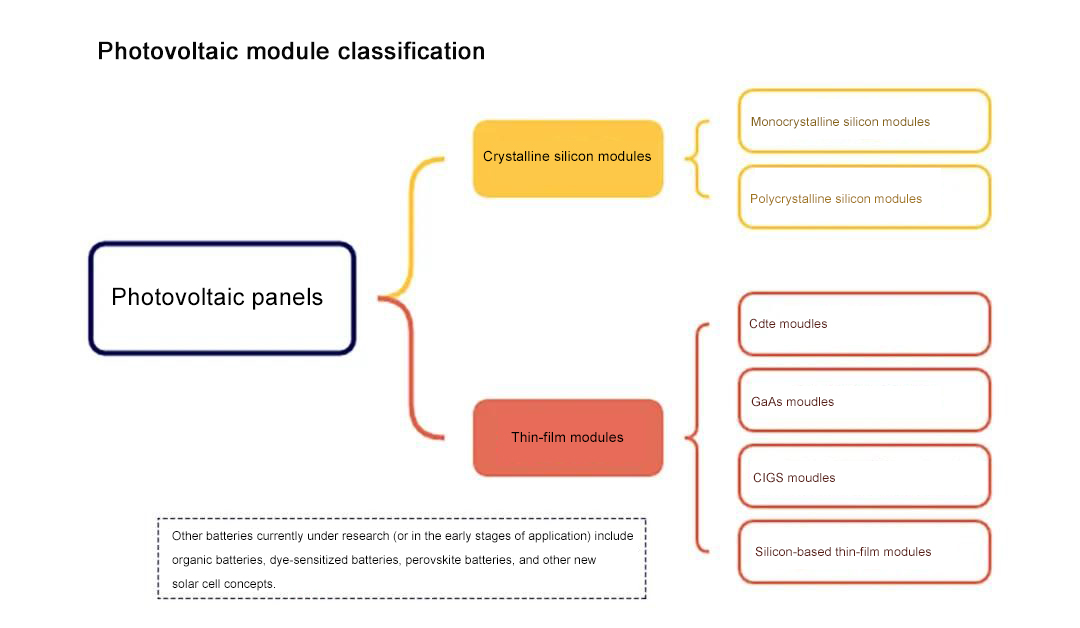
Photovoltaic modules are made from a
variety of materials, primarily crystalline silicon modules and thin-film
modules. Crystalline silicon modules are further divided into monocrystalline
silicon and polycrystalline silicon, while thin-film modules include various
types such as cadmium telluride (CdTe), copper indium gallium selenide (CIGS),
and gallium arsenide (GaAs). In my country's current photovoltaic industry,
crystalline silicon cells dominate the market due to their economic advantages.
However, in the building-integrated photovoltaic (BIPV) market, thin-film cells
have a more pronounced advantage.
This is because in BIPV projects, the angle
of illumination affects the conversion efficiency of traditional crystalline
silicon modules, reducing their ideal efficiency. In contrast, thin-film solar
cells offer significant advantages in BIPV projects due to their superior
low-light performance, low temperature coefficient, excellent durability, good
light transmittance, high aesthetics, and flexible customization.
CdTe thin-film modules are currently the
most widely commercialized thin-film module type, accounting for over 90% of
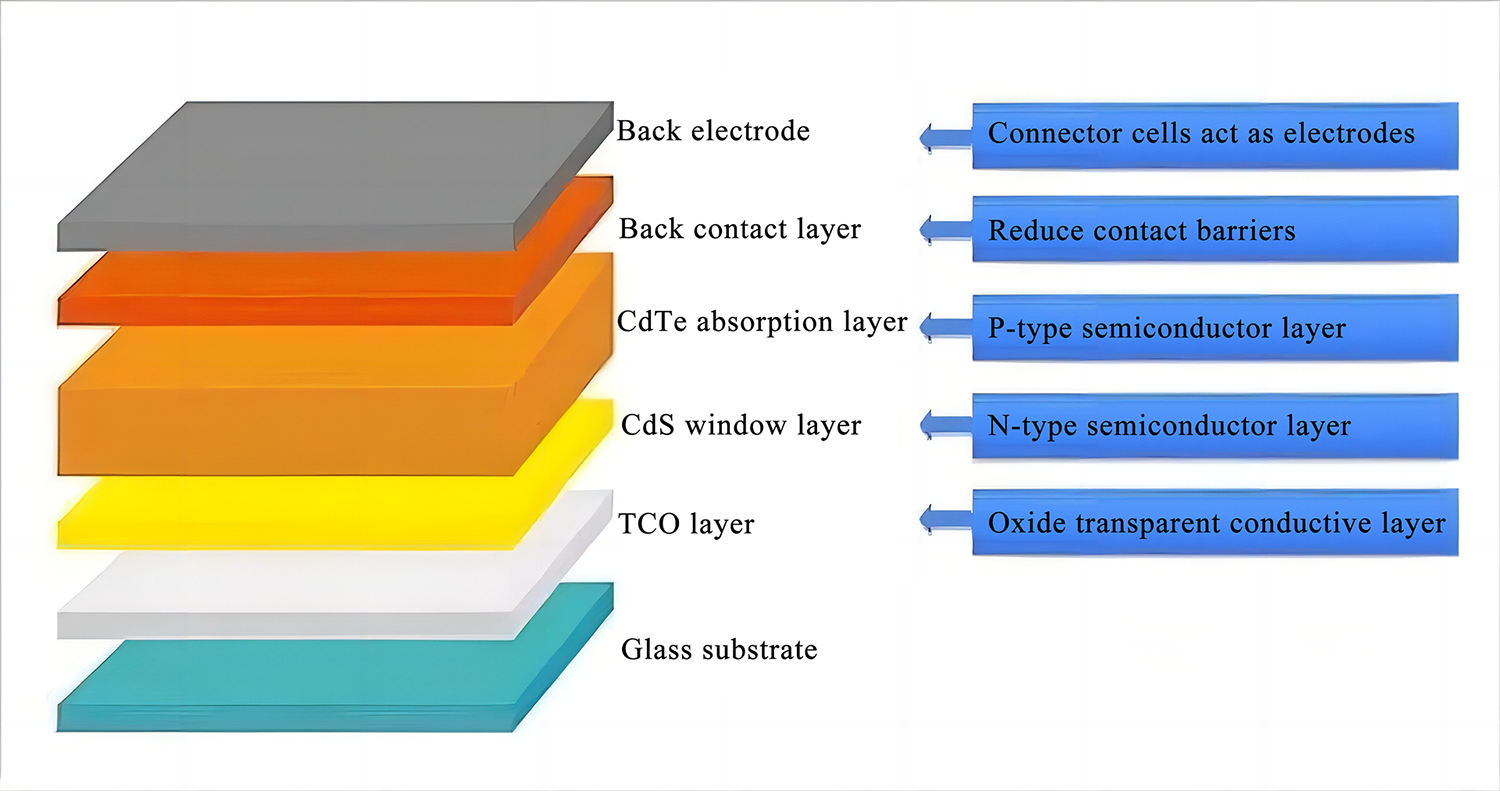
the market. CdTe thin-film modules are photovoltaic devices based on a
heterojunction of p-type CdTe and n-type CdS, formed by sequentially depositing
multiple layers of semiconductor thin films on a glass substrate. They
primarily consist of a glass substrate, a transparent conductive oxide (TCO)
layer, a CdS window layer, a CdTe absorber layer, a back contact layer, and a
back electrode.
Zoom Solar Green Energy Technology is one
of the few domestic new energy high-tech companies with independent
intellectual property rights that researches, develops, and manufactures CdTe
thin-film solar cells and modules. Zoom Solar Green Energy Technology has
invested 2.016 billion yuan in the "Western China Zero-Carbon Intelligent
Manufacturing Industrial Park" in Qinhan New City, Xixian New District,
Shaanxi Province. This park integrates industry, academia, and research,
leveraging its own production lines to achieve a 300MW production capacity for
cadmium telluride thin-film modules. The company's photovoltaic manufacturing
and core coating equipment are all in-house, and all raw materials are sourced
domestically. Zoom Solar Green Energy Technology's latest generation of cadmium
telluride thin-film modules is reportedly expected to achieve a conversion
efficiency of 17%, and this efficiency is continuously improving.

Cadmium telluride thin-film modules have a
wide range of applications in the BIPV field, including in commercial
buildings, schools, hospitals, airports, subway platforms, bus stations, and
large factory workshops. They can be used as a decorative building material,
replacing traditional glass curtain walls, exterior decorative stone, and roof
tiles, while also providing green, environmentally friendly, and clean
electricity for buildings. The following are some common examples of cadmium
telluride thin-film modules in the BIPV field:
1. Building Photovoltaic Curtain Walls
Photovoltaic curtain walls are a novel
architectural curtain wall technology that combines traditional curtain wall
technology with photovoltaic power generation technology, integrating power
generation, sound insulation, thermal insulation, safety, and decorative
features. These highly practical technologies eliminate a building's reliance
on traditional electricity sources, enabling on-site power generation and use,
saving energy and money. They do not emit carbon dioxide or produce greenhouse
gases, making them a net energy source and helping to reduce building carbon
emissions. Furthermore, they can replace some traditional building materials,
further conserving resources.
2. Photovoltaic Carports
"Photovoltaic + Carports" is a
diversified, personalized, and innovative application of the "1+N
Integrated Energy Low-Carbon Service" of cadmium telluride thin-film
modules. They not only perform all the functions of traditional carports but
also provide vehicle charging, achieving efficient energy utilization. Common
photovoltaic carports typically utilize steel structural supports, which are
simple, elegant, stylish, beautiful, and practical. They can be installed in a
wide range of locations, effectively alleviating social, environmental, and
energy pressures.
3. Photovoltaic Sunrooms
Photovoltaic sunrooms have become very
popular in recent years. First, they effectively harness solar energy to
generate electricity, providing green, renewable electricity to homes and
businesses, lowering energy costs and reducing greenhouse gas emissions.
Second, they are often more aesthetically pleasing, showcasing a sense of
artistry and technology. Third, because they utilize advanced thermal
insulation materials, they are less hot in the summer and less cold in the
winter than conventional sunrooms.
4. Photovoltaic Tiles
Photovoltaic tiles, also known as solar
tiles, are a new type of roofing material that utilizes solar energy to
generate photovoltaic power. As a technology that integrates architecture with
renewable energy, photovoltaic tiles not only generate electricity but can also
be incorporated into building components, such as roofs or walls, to enhance
the aesthetics of a building and achieve energy sustainability. The material
and installation costs of photovoltaic tiles are continuously decreasing, while
their photovoltaic conversion efficiency is continuously improving, making them
increasingly economically competitive.
5. Photovoltaic Bus Shelters
The electricity generated by photovoltaic
bus shelters can power various functions, including nighttime advertising
lightbox lighting, station information systems, real-time voice announcements,
free Wi-Fi hotspots, and USB charging ports. This reduces municipal electricity
costs, improves the waiting environment, and enhances the passenger experience.
6. Distributed Photovoltaic Power Generation
on Industrial and Commercial Rooftops
Commercial and industrial buildings
typically feature large, flat rooftops with minimal obstructions, high power
consumption, and high electricity prices, making them ideal for installing
photovoltaic power plants primarily for self-use. Distributed photovoltaic
power generation on commercial and industrial rooftops is a green and
environmentally friendly project, providing insulation, moisture resistance,
and thermal insulation for rooftops, extending their service life while
enhancing their aesthetics.
In short, cadmium telluride thin-film
modules, as a highly efficient and environmentally friendly BIPV material, help
businesses save on electricity costs, generate revenue through the sale of
surplus electricity to the grid, and participate in carbon credit trading. The
cadmium telluride thin-film module has a design life of 30 years, can achieve a
10-year product warranty and 25 years of linear power output. Through power
generation, the cost can be recovered in 6 years, helping various industries to
reduce costs and increase efficiency. It has huge application potential in the
future renewable energy field.