Highly efficient, ultra-thin cadmium
telluride thin-film solar cell technology connects to a green future.
Solar energy is considered an ideal
resource for addressing current global energy challenges. As a virtually
unlimited and environmentally friendly form of energy, it is becoming a key
pillar of the global energy transition. Solar photovoltaic power generation is
currently one of the most widely used methods of utilizing solar energy. Among
various solar cell technologies, cadmium telluride (CdTe) thin-film solar
cells, with their unique advantages of high efficiency, lightweight, stable
performa
 nce, and low cost, are becoming a major thin-film photovoltaic product
in the global photovoltaic market.
nce, and low cost, are becoming a major thin-film photovoltaic product
in the global photovoltaic market.

01 Structure and Working Principle of CdTe
Power Generation Glass
The active layer of a CdTe thin-film solar
cell is typically only a few microns thick, about one-tenth the diameter of a
human hair. A typical cadmium telluride (CdTe) thin film solar cell consists of
five layers:
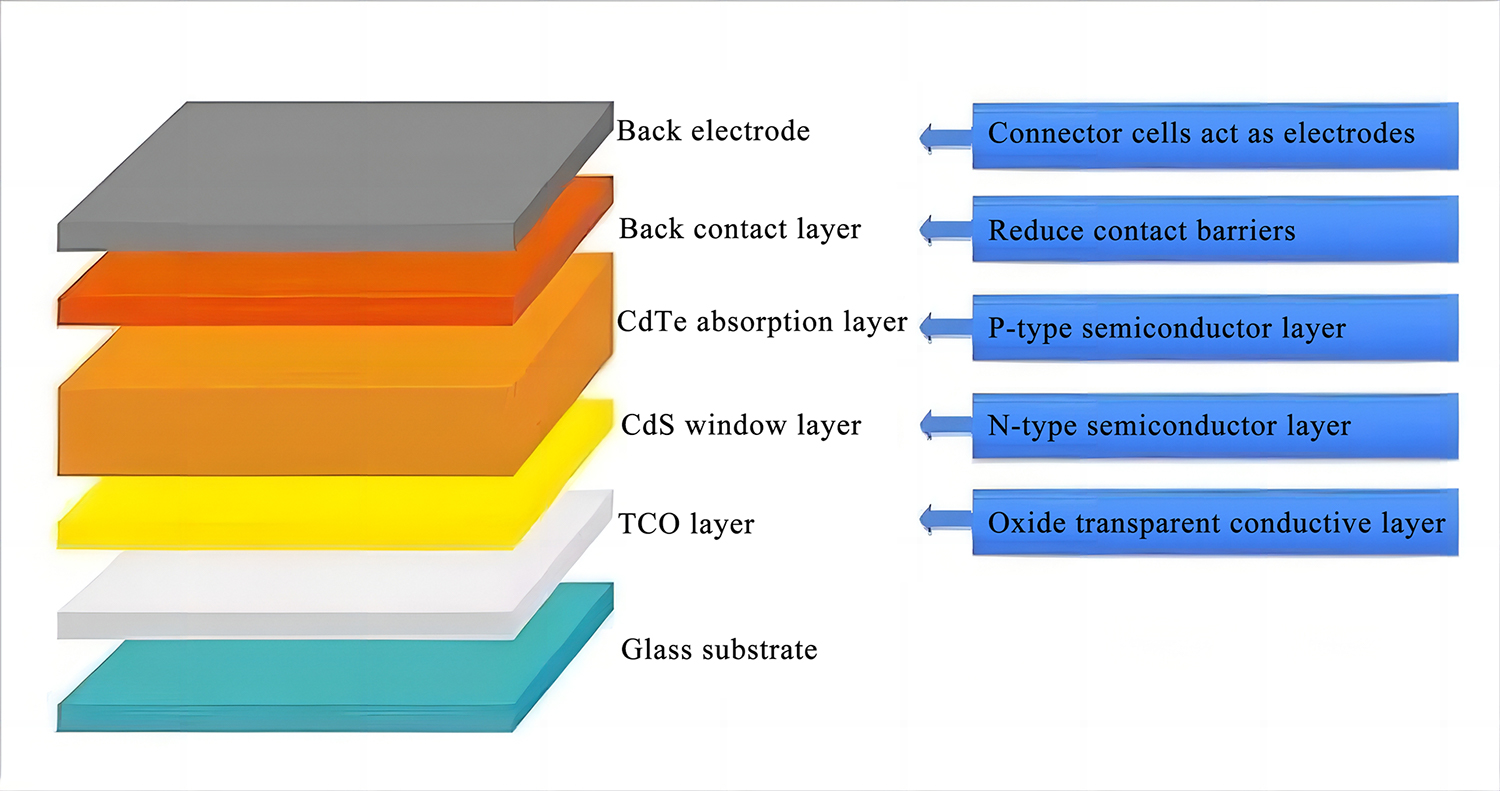
(1) Glass substrate: It mainly acts as a
support for the cell, preventing pollution and incident sunlight;
(2) TCO layer: It is a transparent
conductive oxide layer, such as (SnO₂ or Cd₂SnO₂), which is transparent to visible light and has high conductivity
and can efficiently transmit current;
(3) CdS window layer: It is a cadmium
sulfide window layer, an n-type semiconductor, which forms a p-n junction with
p-type CdTe. CdS is basically non-reactive for wavelengths above 520nm.
Transparent, and allows the CdTe absorption layer to collect lower energy
photons to generate electron-hole pairs under light;
(4) Cadmium telluride (CdTe) absorption
layer: can achieve an optical absorption rate of more than 90% in less than 2μm
thickness. Most carrier generation and collection occur here. The p-n junction
formed with the n-type CdS window layer is the core part of the entire battery;
(5) Back contact layer and back electrode:
in order to reduce the contact barrier between CdTe and the metal electrode,
draw out the current, and make the metal electrode and CdTe form an ohmic
contact. The back plate functions as sealing, insulation, and waterproof
(generally made of TPT, TPE and other materials must be aging-resistant).

In addition, the complete CdTe power
generation glass assembly also includes a junction box (protecting the entire
power generation system and acting as a current transfer station) and an
aluminum alloy protective laminate (playing a certain sealing and supporting
role). Its specific working principle is that when sunlight shines on the
surface of a cadmium telluride solar cell, the energy of the photon excites the
electrons in the semiconductor, causing them to jump to the conduction band,
while leaving a hole in the valence band, thus forming a photogenerated
electron-hole pair. Due to the design of the cell structure, electrons and
holes are guided to different areas for separation, with electrons being guided
to the electron transport layer and holes being guided to the hole transport
layer. Ultimately, the separated electrons and holes are guided to the
electrodes, forming a current, thereby generating electrical energy.
02 How is cadmium telluride power
generation glass manufactured?
The manufacturing process of cadmium
telluride power generation glass components can be divided into four main
steps:
(1) Material production: Cadmium and
tellurium are by-products of zinc and copper mining operations, respectively.
The waste generated by these mining processes has so far produced enough
cadmium and tellurium, so no additional mining is required. The raw materials
can be refined to produce pure cadmium and tellurium.
(2) Cell production: Cadmium telluride
(CdTe) vapor is deposited on a coated conductive glass plate. After several
rounds of laser scribing and material deposition and processing, the cell
structure is finally formed.
(3) Module assembly: By adding electrical
contacts to connect to other modules, adding edge sealants and a layer of
encapsulant for weatherproofing, and finally the glass backplane, the completed
cell is turned into a module assembly.
(4) Component deployment: The module is
installed in the frame and connected to other module assemblies to produce
green and clean electricity.

03 Application advantages of cadmium
telluride power generation glass
The high efficiency and ultra-thin
characteristics make cadmium telluride power generation glass components show
great application potential in the field of building integrated photovoltaic
(BIPV). They can be perfectly integrated into architectural design to achieve
the unity of beauty and practicality. At the same time, cadmium telluride power
generation glass has won wide recognition in the market for its high stability
and low attenuation rate. Experimental data shows that the annual attenuation rate
of cadmium telluride power generation glass is only 0.5%, which means that
after 25 years, the component can still maintain more than 89% of the power
generation capacity. Furthermore, CdTe solar glass exhibits excellent
temperature coefficient and spectral efficiency, further enhancing its energy
yield advantage by providing 4% more energy annually in hot climates and high
humidity conditions.

In addition to high efficiency and
stability, CdTe solar glass also offers numerous advantages, including strong
low-light power generation capabilities, large product area, low temperature
coefficient, minimal hot spot effect, and high safety performance. These
advantages enable CdTe solar glass to maintain excellent power generation
performance in a variety of climate conditions and installation environments,
providing strong support for the widespread adoption of renewable energy.

While pursuing high efficiency and
stability, CdTe thin-film solar cells also prioritize environmental protection
and sustainable development. The main raw materials for CdTe photovoltaic
modules are tellurium and cadmium, elements that are widely present in nature
and can be recycled and reused sustainably. Furthermore, CdTe solar glass has a
very low carbon footprint, 2.5 times lower than crystalline silicon modules
over its lifecycle, and a water footprint three times lower, helping to reduce
environmental pressure and promote green and low-carbon development.

Looking ahead, with the accelerated
advancement of scientific research and industrial progress, cadmium telluride
power generation glass will be applied and promoted in a wider range of fields.
In the fields of building photovoltaic integration, household photovoltaic
power stations, industrial and commercial buildings, and industrial
manufacturing, CdTe thin-film batteries will play an important role and inject
strong impetus into the development of green energy.